F-1 Students and US Public Schools: The Limits, Grade by Grade
กำลังเตรียมคำแปล ขณะนี้แสดงต้นฉบับภาษาอังกฤษ
According to the US State Department and Homeland Security, F-1 students cannot attend public schools in grades K-8 and may attend public high school for at most 12 months. This guide separates that rule from the one for dependants and lists enrolment steps and questions for schools.
เขียนและตรวจสอบข้อเท็จจริงโดย AI จากแหล่งข้อมูลทางการ · ตรวจสอบล่าสุด 2026-10-29
ข้อมูลวีซ่าในหน้านี้สรุปจากแหล่งข้อมูลทางการ ไม่ใช่การพิจารณาคุณสมบัติ โปรดยืนยันสถานการณ์ของคุณกับหน่วยงานทางการหรือผู้เชี่ยวชาญด้านการเข้าเมืองเสมอ
This guide is for parents considering US study, especially families whose school-age child might study on an F-1 student visa. It is easy to assume public school is free or cheap. But the limits depend on visa type, so check the rules before you choose a home. Everything below rests on official US government guidance (compiled as of 2026-10-29). Rules can change, so always check the latest guidance.
The public-school limits for F-1 students
According to US Homeland Security and State Department guidance, F-1 students cannot attend public schools in kindergarten to grade 8. They may attend public high school (grades 9-12) for no more than 12 months in total, counting all public schools together.
High school comes with a further condition. The full unsubsidised per-capita cost must be paid before the visa application. The State Department cites typical costs of $3,000 to $10,000. Proof of payment must be shown at the visa interview and at the port of entry.
SEVP-certified private schools are described as having no time limit. So it is worth understanding the difference between public and private. Ask each school directly whether it holds SEVP certification.
Dependants are described differently
The State Department says the public-school restrictions apply to F-1 student visas. They do not apply to the children of exchange visitors, diplomats or foreign workers. It also says dependants of nonimmigrant visa holders in most categories, including F-1, may attend public primary schools and other public institutions as appropriate.
So read the two cases separately: a child who is the F-1 student, and a child who is a dependant on a parent's visa. This article cannot decide which applies to your child. Confirm with the official authority or an immigration professional.
Guidance also says public high school attended in a status other than F-1 does not count toward the F-1 12-month limit.
If a child stays on after the parents move home, student-visa rules like these usually apply. Guidance advises checking early.
How public school enrolment works
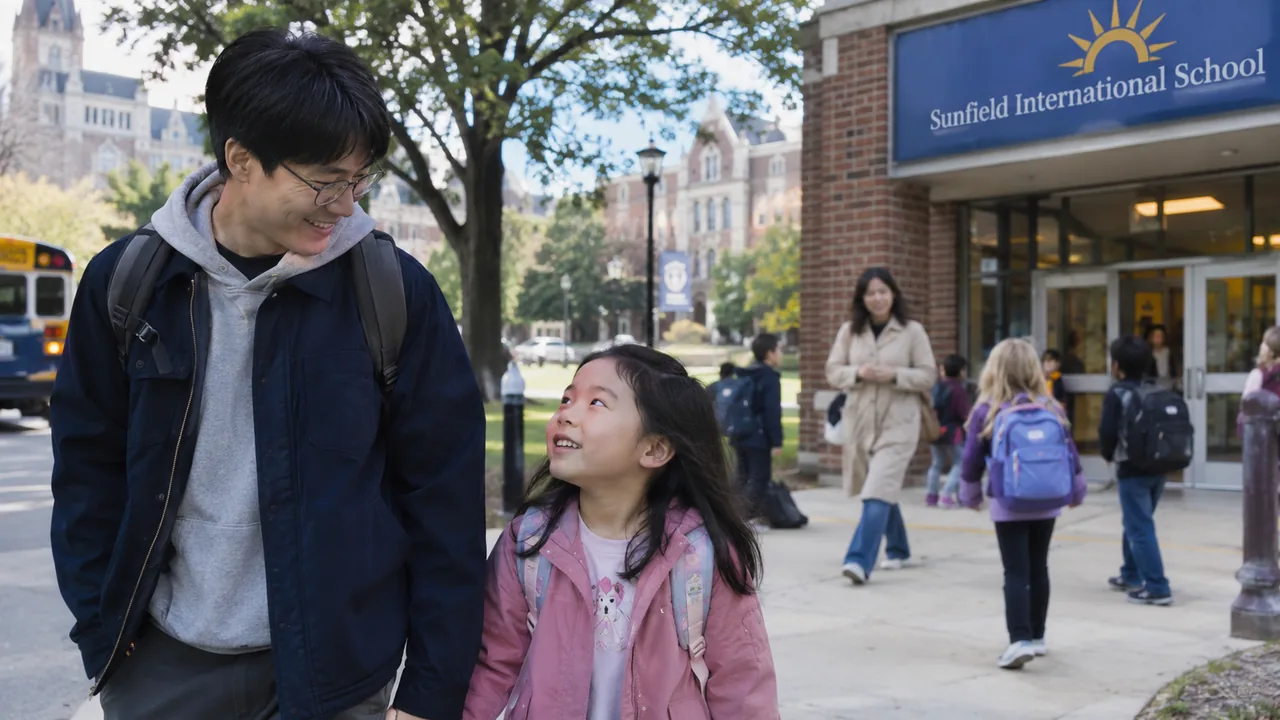
Even where there is no restriction, you should know the process. US public schools enrol through the local school district. Schools may ask for proof of address (such as a utility bill), proof of age and immunisation records. Districts list the required documents on their websites.
The US Department of Education says all children have equal access to free public education regardless of citizenship or residency status, and that schools cannot require documents that block or discourage enrolment. The restrictions on F-1 students are set out separately by the State Department and Homeland Security. How both apply to your child is best confirmed with the district and the official authorities together.
Your address decides the school
In the US, a home address decides the assigned (base) public school. Fairfax County Public Schools in Virginia, for example, publishes a locator where you enter an address. It also publishes elementary, middle and high school boundary maps and feeder maps. Check the assigned school on the district site before renting or buying. Boundaries can change.
Grade bands also vary. US schooling runs 12 grades after kindergarten. But which grades form elementary, middle and high school, and the age cut-off date, depend on state and district rules. Do not simply map them onto Korean grades; ask the district.
Getting English support
Public schools must identify English learners, assess their needs and provide a language assistance programme. Enrolment usually starts with a Home Language Survey, followed by an English assessment if indicated. Schools must communicate with parents in a language they understand, including interpreters and translations. Parents give permission for services and may decline them.
Checklist
- Have you separated whether your child is the F-1 student or a dependant on a parent's visa?
- Have you confirmed whether your child's grade is K-8 or 9-12?
- If considering public high school, do you understand the 12-month cap and the full-cost payment condition?
- Can you prepare proof of payment for the interview and port of entry?
- Have you checked whether a private school is SEVP-certified?
- Have you checked the assigned school for an address on the district site before choosing a home?
- Have you prepared proof of address, proof of age and immunisation records?
- Have you looked at the rules early for a child who may stay after the parents leave?
Ask the school
- Ask whether your child's visa status allows admission and which documents are needed.
- For a private school, ask whether it is SEVP-certified.
- For public high school, ask how much the full cost is and when and how it is paid.
- Ask how English assessment and language support work, and whether interpreters are provided for parent communication.
- Ask for the assigned school for your address, the grade structure and the age cut-off date.
Always confirm your own situation with the official authority or an immigration professional.
แหล่งที่มา
เราสรุปแหล่งข้อมูลเหล่านี้ด้วยคำพูดของเราเอง กฎเกณฑ์และค่าเล่าเรียนเปลี่ยนแปลงได้ โปรดยืนยันกับแหล่งต้นฉบับและโรงเรียนเสมอ
- Structure of U.S. Education: General Information — U.S. Department of State (InfoUSA) · ตรวจสอบเมื่อ 2026-10-29
- English Learner Family Toolkit: Enrolling Your Child in School — U.S. Department of Education (NCELA) · ตรวจสอบเมื่อ 2026-10-29
- Maps (school boundaries) — Fairfax County Public Schools · ตรวจสอบเมื่อ 2026-10-29
- School Obligations (English learners) — U.S. Department of Education (NCELA) · ตรวจสอบเมื่อ 2026-10-29
- Foreign Students in Public Schools — U.S. Department of State · ตรวจสอบเมื่อ 2026-10-29
- Kindergarten to Grade 12 Students — U.S. Department of Homeland Security (Study in the States) · ตรวจสอบเมื่อ 2026-10-29
มีคำถามเกี่ยวกับสถานการณ์ของลูกคุณเองไหม ถาม Sam ได้เลย
 ถาม Sam